

How 2026 Will Be a Pivotal Year for Canada’s Circular Economy

Predictions and optimism for the year ahead​

The end of 2025 marked an important five-year milestone for the Circular Innovation Council under its expanded, national mandate. Now one month into 2026, as we continue the momentum created alongside our members and partners, we look to leverage past achievements to make 2026 a pivotal year for Canada’s transition towards a circular economy.  

In 2025, collaboration deepened through milestone events like the Canadian Circular Economy Summit and the release of the leveled-up Circular Economy Action Plan for Canada 2.0. Cities and communities nationwide adopted roadmaps and action plans, domestic procurement gained attention as an engine for local, low-carbon markets, and awareness surged with over 5 million Canadians engaging through the Circular Economy Month campaign. These advances position 2026 as a breakthrough year.

Gaining more traction year after year

As the concept takes hold, recognition of the benefits of a circular economy continues to gain momentum, particularly its ability to address some of today’s biggest issues: affordability, economic uncertainty, resource and nature preservation, and climate change. While the fundamentals of a circular economy – reuse, repair, reduce, recycling, and sharing have been part of society for centuries, the circular economy concept and systems change were  introduced a mere 15 years ago. The infamous Rethinking Progress video, launched by the Ellen MacArthur Foundation in 2011, and the Butterfly Diagram were among the first materials widely used to communicate what the circular economy is all about. CIC began introducing the concept to Canadians during the 2017 Waste Reduction Week campaign featuring The Beer Store’s deposit return program, which has been in operation since 1927 as a clear example of an effective circular system.  

Fast forward to today, considerable progress has been made to move the circular economy into the mainstream, not just as an environmental policy but as an industrial and economic policy that redefines value of materials. Many Canadians regularly participate in the circular economy without ever hearing the term, while ironically its being profiled in the media as the way of the future that could save the world, but many don’t know what it means.

A recent Forbes article reports that 2026 could be a breakout year for the circular economy, offering validation for CIC and encouragement to double-down on our leadership efforts. 

Clear Signals That 2026 Will Be a Pivotal Year for Canada

1. Buying Canadian, Creating a Resilient Local Economy

The Buy Canadian movement, while focused on building domestic economic resilience, also offers potential to drive local circular systems, built by shortening supply chains. Combining dual commitments to domestic economic growth and low-carbon innovation will naturally deliver on the principles of the circular economy – one silver lining to the current trade disputes. 

Focusing on local purchasing and Canadian-made products shortens supply chains, reduces costs and transportation-related carbon emissions, keeps jobs and skills rooted in local communities, and helps us get the most value from materials made here in Canada while protecting our vast resources, such as critical minerals and lumber.

The Elbows-Up, Buy Canada movement rapidly took off in early 2025 as governments, businesses and consumers leaned in to do their part in responding to punitive foreign tariff policies. One year later, the momentum continues gain strength, and studies predict the movement is here to stay.

Governments have pivoted quickly as more roll out Buy Canadian policies, demonstrating the power of public buying to influence markets. As a long-time advocate of circular procurement, CIC sees an exciting opportunity to leverage and connect of Government of Canada’s new Buy Canada policy with the shaping of local, circular markets. Circular procurement strengthens the domestic supply base by increasing demand for sustainable Canadian materials — those reused, recycled, remanufactured, or sustainably produced in Canada. It ensures those materials come from Canadian recycling, remanufacturing, or secondary production streams.

Together, Buy Canadian polices and circular procurement practices can lay the foundation for domestic circular supply chains and business models, from repair and refurbishment to sharing and product-as-a-service systems.

2. Local Action Driving National Change

Canadian municipalities are leading Canada’s circular economy transition. Over 5 short years, numerous local governments have made released circular economy roadmaps, procurement strategies, circular food systems flow reports, established community grant programs, and implemented innovative pilots. Leadership is coming from major cities like the City of Toronto’s 10-year Circular Economy Road Map, which is just kicking off, City of Richmond’s Circular City Strategy, and the City of Montreal’s 2024-2030 Roadmap, but also from smaller and northern communities too. Just this month, we saw the District of Squamish release an RFP for a first-of-its-kind community-based Labour Force Plan aiming to build a local workforce with the skills and knowledge to advance its circular ambitions.

These local circular strategies place greater emphasis on piloting or scaling up-reuse and repair efforts, boosting economic development, and increasing public education on the social, economic, and environmental benefits of circular actions. Many communities are already implementing this through innovative initiatives like Strathcona’s Hodge-Podge Lodge, Bowen Island’s Knick-Knack Nook Reuse Store, Lenderies across York Region public libraries, and Banff’s Re-Use it Centre which is being reimagined to become a full circular Hub.

Local governments are centres of consumption, centralized generators of waste, and large emitters of greenhouse gases. They are also critical hubs for circular innovation, play a key role in citizen education, and, together, their total public buying power represents over 15% of Canada’s GDP. Canada’s circular economic transition, at the pace needed, is highly reliant on local government leadership. CIC predicts 2026 will be the year to watch the sector demonstrate its leadership in driving change

Ville de Montréal - Host of the 2025 Canadian Circular Economy Summit

3. Circularity moving to the centre of climate action

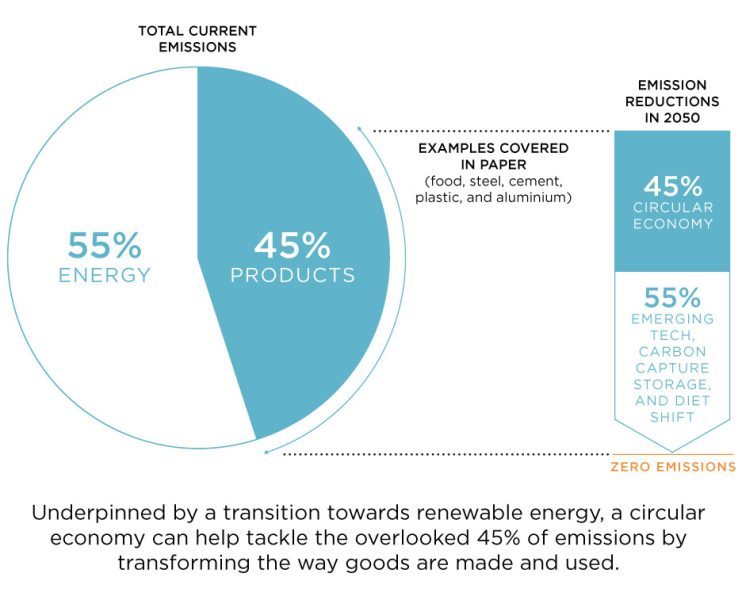
Environment and Climate Change Canada’s latest global mean temperature forecast indicates that 2026 will likely be among the hottest years on record, comparable to 2023 and 2025 and approaching 2024, which remains the warmest year ever observed. Rising temperatures and extreme weather events continue to cause increased damage to infrastructure, costing  Canadian communities billions to repair. While we may be preoccupied with international trade threats and economic disruptions, the costs of climate change are still very real.  In addition to carbon emission reduction initiatives, low carbon vehicles, and transition to renewable energy infrastructure, there are critical actions that only a circular economy can address.  The next frontier and arguably the most important will be addressing the 45 percent of overlooked emissions generated from how we make, use, and dispose of products and food. In 2026, circularity can no longer be a complementary climate solution – it is central to achieving climate goals.

Tackling Overlooked Emissions
Image courtesy Ellen MacArthur Foundation

4. Smart and affordable consumption going mainstream

In today’s digital age, it’s now easier than ever to influence consumer behaviours.The internet and social media constantly show us ads and content about new trends and products. This often creates a sense of urgency and inadequacy, leading to greater consumption. Whether its  social media influencers sharing weekly shopping hauls or the latest Stanley Mug, or marketing emails that play on the fear of missing out around events like Black Friday – these messages increase pressure to buy.

Amid an affordability crisis, consumers are rethinking how they consume. A new social media trend, ‘underconsumption core,’ began gaining traction in 2024 to promote minimalism and circular practices such as repairing, reusing, and sharing. More content showing thrift store hauls, ‘clear out the fridge’ cooking recipes, and instructional repair videos have become increasingly popular.

As Canadian consumers continue to face affordability pressures and are now more than ever thinking about where their products and food come from, we expect smarter consumption will continue to catch on in 2026.

Companies are acknowledging the trend. Take IKEA Canada, for example, which last year launched a PSA campaign advocating the elimination of consumer taxes on secondhand goods while also encouraging customers to shop in its As-is section, increasing secondhand sales by 192%.  Governments seeking strategies to reduce costs are motivated to examine tax policies that could make circular products and business strategies more attractive and accessible.
Building on the Momentum

Leadership followed by broad adoption across all facets and levels will be needed to address today’s economic, social, and environmental challenges. The momentum towards a circular economy has been building over recent years, but the exponential growth in its capacity to deliver on what Canadian’s value most is reaching an encouraging threshold.

We can draw on the words of Prime Minister Mark Carney’s recent speech at the World Economic Forum to build confidence that we can secure support for a strong, resilient, and circular economy.  


"...That’s building a strong domestic economy. It should be every government’s immediate priority.” … “Canada has what the world wants. We are an energy superpower. We hold vast reserves of critical minerals. We have the most educated population in the world” ... “Canadians remain committed to sustainability.”
- Prime Minister Mark Carney, January 2026

Small steps, many people, real change: let’s work together in 2026

In whatever capacity available to us – as citizens, consumers, policy makers, business leaders, scientists, students – we all can contribute to advancing an economy.

Forbes has predicted that 2026 is the year for the Circular Economy… who are we to argue!

What are your circular predictions for the year ahead? Get in touch: info@CircularInnovation.ca

JOIN US

Become a Member

We offer collaborative opportunity and inspiration to redefine value in communities across Canada through showcase opportunities and putting circular economy concepts into action.