
Canada’s agriculture sector is a global leader, spanning 62.2 million hectares of vast farmland, supporting diverse commodities, and powering strong exports. The food system contributed $149.2 billion (7% of Canada’s GDP) in 2024 alone, employing 2.3 million people through major commodities like grains, vegetables, oilseeds, meat, dairy, and processed foods.
But as the sector has grown, so has its environmental impact. Decades of intensive practices like the use of heavy tillage machinery and fertilizer consumption have contributed to degraded soil health, biodiversity loss, greenhouse gas emissions, and pollution. In 2023, greenhouse gas emissions in the sector accounted for 55 megatonnes, or 8% of total emissions in Canada.
The food sector is critical to Canada’s circular economy as it encompasses a staggering $58 billion in annual avoidable food waste – addressing this means mitigating significant environmental damage while generating economic value. By shifting from a linear, take-make-dispose model toward circular practices, the sector can reduce emissions, enhance food security, regenerate soils, create local jobs, and strengthen supply-chains.
Farmers, governments, and organizations across Canada’s food value chain have already begun work to transform the industry to one that is more sustainable and resilient. Through practical farming practices that focus on restoring soil health – including through compost generated from food waste – and maximizing value of natural resources, regenerative agriculture has the potential to drive long-term economic growth in Canada’s agri-food sector while delivering substantial environmental and social benefits. However, despite growing interest, Canada currently lacks a clear definition and unified understanding of regenerative agriculture – creating barriers to adoption and impact. The Canadian Standards Association is helping change that through foundational research and development of a new standard.
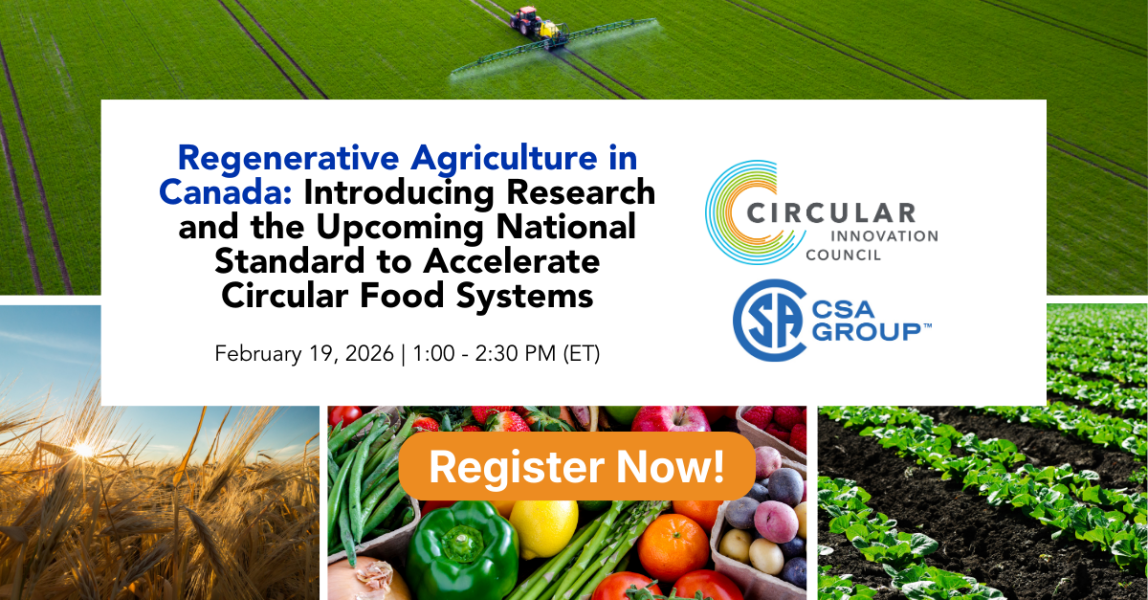
On the heels of Canada’s Agriculture Day, Circular Innovation Council and CSA Group are co-hosting a webinar to discuss the realities and potential of regenerative agriculture and how this holistic farming approach is critical to Canada’s circular economy.
We invite you to join us to:
Attendees will have the opportunity to submit questions to the panel in advance of the webinar.
Who should attend?
This free, open webinar is designed for:
Register for an insightful session to learn, connect, and help shape the standards that will support the future of regenerative agriculture in Canada.

Jo-Anne St. Godard
Executive Director, Circular Innovation Council

Catherine Tays
Manager, Strategic Initiatives Manager for Emerging Programs at Canadian Standards Association, supporting CSA’s Agriculture and Agrifood Program
Dr. Catherine Tays is the Strategic Initiatives Manager for Emerging Programs at CSA Group (Canadian Standards Association). In her role, Catherine helps identify areas and ways in which standards can play a role in supporting and advancing the agriculture and agrifood sector, including agricultural sustainability, data and reporting, food loss and waste, and more. Catherine has a PhD in Microbiology and Biotechnology and Chemical Engineering from the University of Alberta.

Jury Gualandris
Professor of Operations Management, Abell Hodgson Chair in Regenerative Agriculture, and Director of Ivey Building Sustainable Value Centre
Jury is an Associate Professor of Operations Management & Sustainability and the endowed Abell-Hodgson Chair in Regenerative Agriculture at Ivey Business School, Western University. As Academic Director of both the Building Sustainable Value Research Centre and the Network for Business Sustainability, he helps lead interdisciplinary initiatives that accelerate business contributions to a fairer and more ecologically resilient future. His research examines supply chains as complex, self-organizing systems, with a focus on how organizations can collaborate to build more circular and regenerative supply chains. He investigates supply chain processes that regenerate local communities and ecosystems, and the governance structures and collectively rationalized beliefs supporting these outcomes.
Jury also contributes to national standards development through his work with the Canadian Standards Association on Food Loss and Waste, and Regenerative Agriculture. Jury’s scholarship appears in leading journals in operations and supply chain management and industrial ecology, and has been featured in major media outlets. He serves on multiple editorial boards and has received numerous international awards for research, teaching, and impact. He is also a member of the Complex Adaptive Supply Network – Research Accelerator at Arizona State University.

Amr Addas
Senior Director, Sustainable Finance and Insights,
Farm Credit Canada (FCC)
Amr leads the FCC team dedicated to promoting financial and non-financial solutions that support the implementation of sustainable practices in the Canadian agriculture and food industry. Since 2010, Amr has offered advisory services to financial institutions on developing investing strategies, serving on investor sustainability advisory boards, and working with groups that highlight Montreal as a global hub for sustainable finance. This includes the Finance and Sustainability Initiative, Finance Montreal’s Sustainable Finance Working Group, and the advisory committee for developing a sustainable finance roadmap for Quebec.
In 2025, Amr was awarded the King Charles III Coronation Medal in recognition of his work in advancing sustainable finance in Canada. Amr has an MBA from the University of Michigan and a B.Sc. in mechanical engineering from the American University in Cairo.
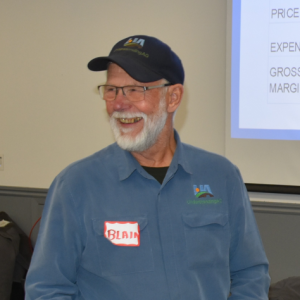
Blaine Hjertaas
Regenerative farmer past 30 years, Holistic educator,
Soil health consultant at Understanding Ag
Blaine has been a farmer for over 50 plus years, practicing regenerative agriculture for the last 30. He became a Holistic Educator in 2008. Blain has done many seminars, courses and short schools on grazing systems, farm finances, cropping systems and soil health. He began work in 2019 with Understanding Ag as a soil health consultant working on a project on the eastern prairies sponsored by General Mills, with 45 farms with the goal of making them more regenerative. This project is still active.

Elizabeth Sheppard
CPA, Senior Manager Planet Friendly Practices, McCain Foods
Elizabeth Sheppard is an accomplished finance and sustainability professional currently serving as the Sr. Manager of Planet Friendly Practices, leading sustainability for McCain in North America. With extensive experience in regenerative agriculture financing, supply chain, and sustainability, Elizabeth has driven groundbreaking initiatives such as the first-of-its-kind financing partnership between McCain Foods and Farm Credit Canada and the execution of the McCain–McDonald’s Future of Potato Farming Fund. She is dedicated to delivering on McCain’s ambitious sustainability commitments. Elizabeth holds a Bachelor of Commerce, Honours, from Smith School of Business at Queen’s University and is a Chartered Professional Accountant.
Our panel is here to answer your questions about regenerative agriculture and the upcoming standard. Send us your questions for consideration.
This free, open webinar is made possible through a partnership with CSA Group. However, many of our webinars are exclusive to CIC members. Become a member today to stay up to date with circular economy news, support our innovative projects, and receive invites to exclusive learning opportunities. Contact Info@CircularInnovation.ca to get started.
Interested in collaborating with us on a future webinar or support other learning initiatives? Contact Caitlin@CircularInnovation.ca to explore partnership opportunities.
We respectfully acknowledge that we live, work and play on the traditional territory of many Indigenous Nations and we humbly extend our respect to Indigenous individuals, communities and Elders, past and present, as the traditional custodians of this land.
Circular Innovation Council is a registered charity.
Charity Registration Number: 119112118 RR 0001